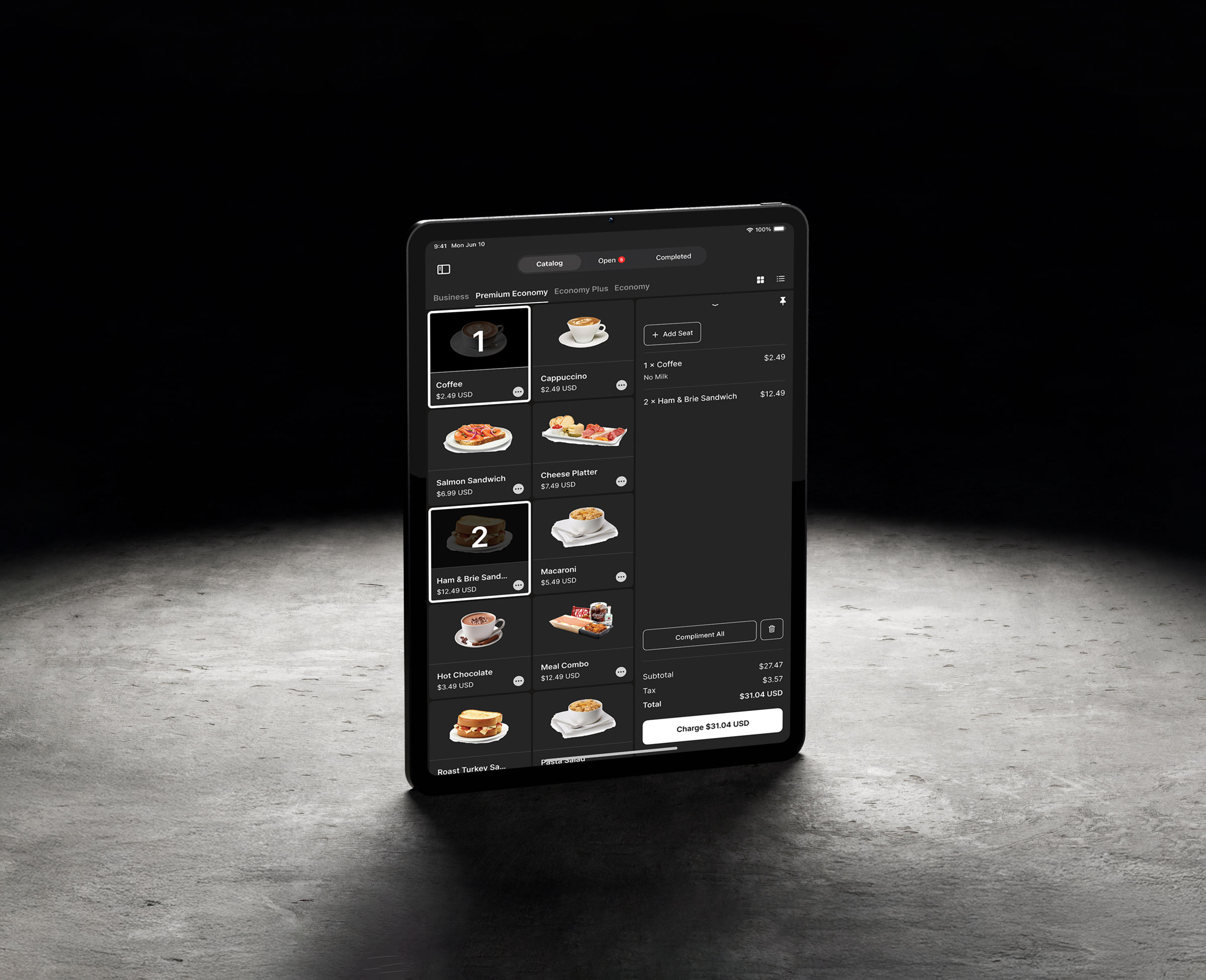
Crew App
Next-gen meal fulfillment in the air
To supercharge the in-flight meal experience, we built a smooth and powerful crew app that unlocks passenger self-serve ordering and makes fulfillment easy. We crafted a purpose-built visual language with intentional motion, streamlined excess actions, and tuned for special accessibility needs.
The result: flight crews that sell more, waste less, and fulfill faster.
-26%
Food Spoilage
+$1.54 million
Projected single-airline annual revenue
~33%
Reduction in payment decline rates
ROLE
Senior Product Designer
TIMELINE
Aug 2023 - Feb 2025
TOOLS
Figma
PLATFORM
ipadOS 13+
ORGANIZATION
Guestlogix
Context
Background
This project was initiated for three main reasons.
1
Migration to Swift
Though user satisfaction was decent with our existing point-of-sale app, it was built on .NET developer platform Xamarin and was losing Microsoft support. It was a slow platform with serious limitations.
After a hasty migration to its likewise-limited successor, .NET Maui, it quickly became clear: the key for this app to shine was to build a native Swift app.
I advocated with stakeholders to take advantage of this rebuild to redesign the app.
2
Spoilage impacting revenue
A meal item that's stocked onto a flight, but goes unpurchased, ends up being thrown out. For our partner airline, Porter, food spoilage like this was the result of low sales, then further exacerbated by overstocking due to guaranteed-selection meal promises.
In 2024, spoilage cost Porter Airlines $3.3 million dollars across 27,672 flights.
3
Receive guest app orders
To receive guest app meal orders, we needed to build a mesh network protocol in the crew app, as well as integrating those new guest-placed orders into the flight attendants' order fulfillment flow.
Strategy
Research and testing
As part of our initiative to build a next-generation meal ordering platform on board aircraft, we conducted user tests, ride-alongs, and test flights where we gathered user insights through observation and interviews. We also gathered feedback through our working relationships with our existing point-of-sales airline customers.

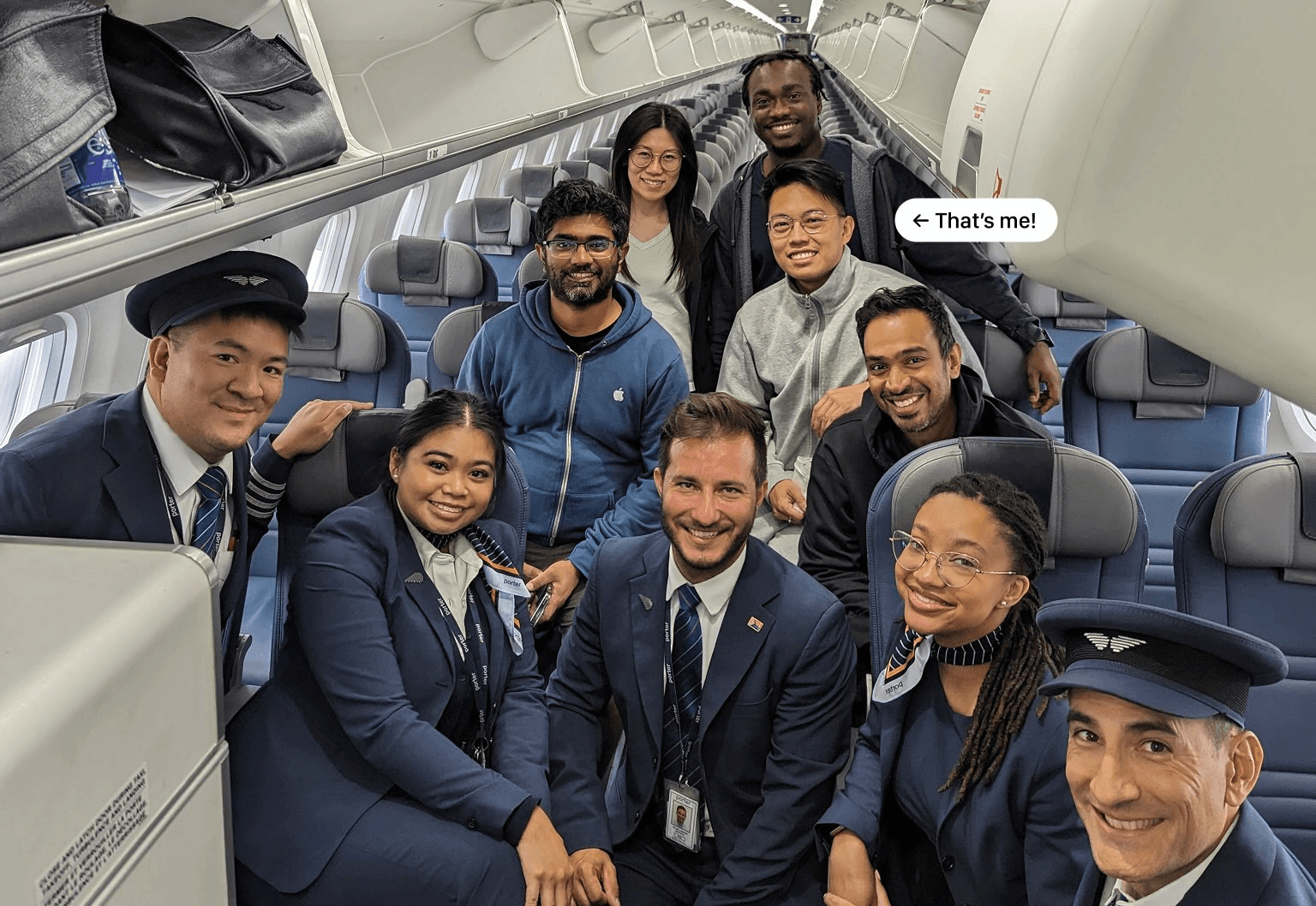
Checkout flow
Outcome
Better workflows
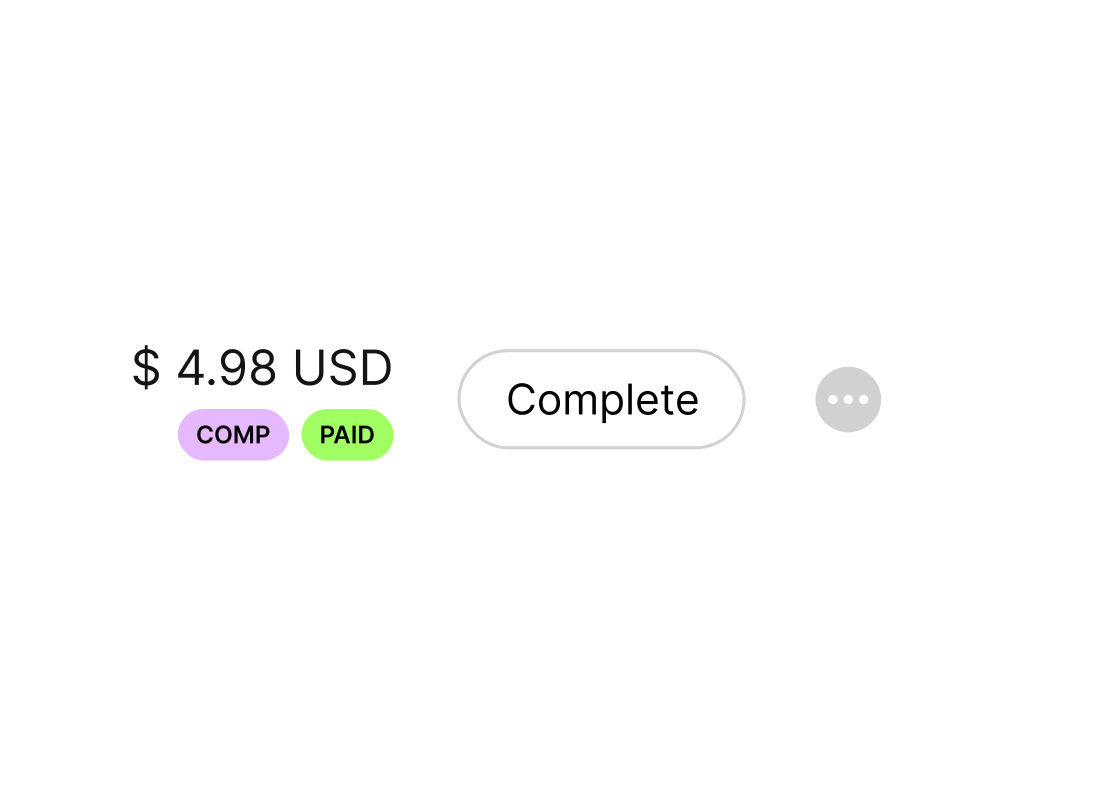
Using the guest app, a passenger orders with their phone and completes payment if they're online. By doing so, the order creation and payment tasks are completed on behalf of the flight attendant, saving them valuable time.
With this improvement, ordering, payment, and fulfillment of the item are now decoupled — allowing these tasks to be finished at different times.
The result: flight attendants have less on their plate and more control over their workflow, unlocking flexibility that can help them prioritize and juggle their many duties.
Cabin-Friendly Touch Targets
Flight attendants have special accessibility needs like using an app in a shaky environment.
Easy To Use
Training is a big pain point for airlines. Intuitive patterns and micro-interactions reduce the need for extensive onboarding, saving airlines money, time, and bureaucratic headache.
Apple Components
Using native iPadOS components accelerates development and lowers the need for testing and troubleshooting.
Overhauled Firmware updates
We overhauled the card reader firmware update user experience, improving the messaging to emphasize importance where needed, subsequently reducing lost payments from 5 to 3 percent, a significant return to the airline's revenue.
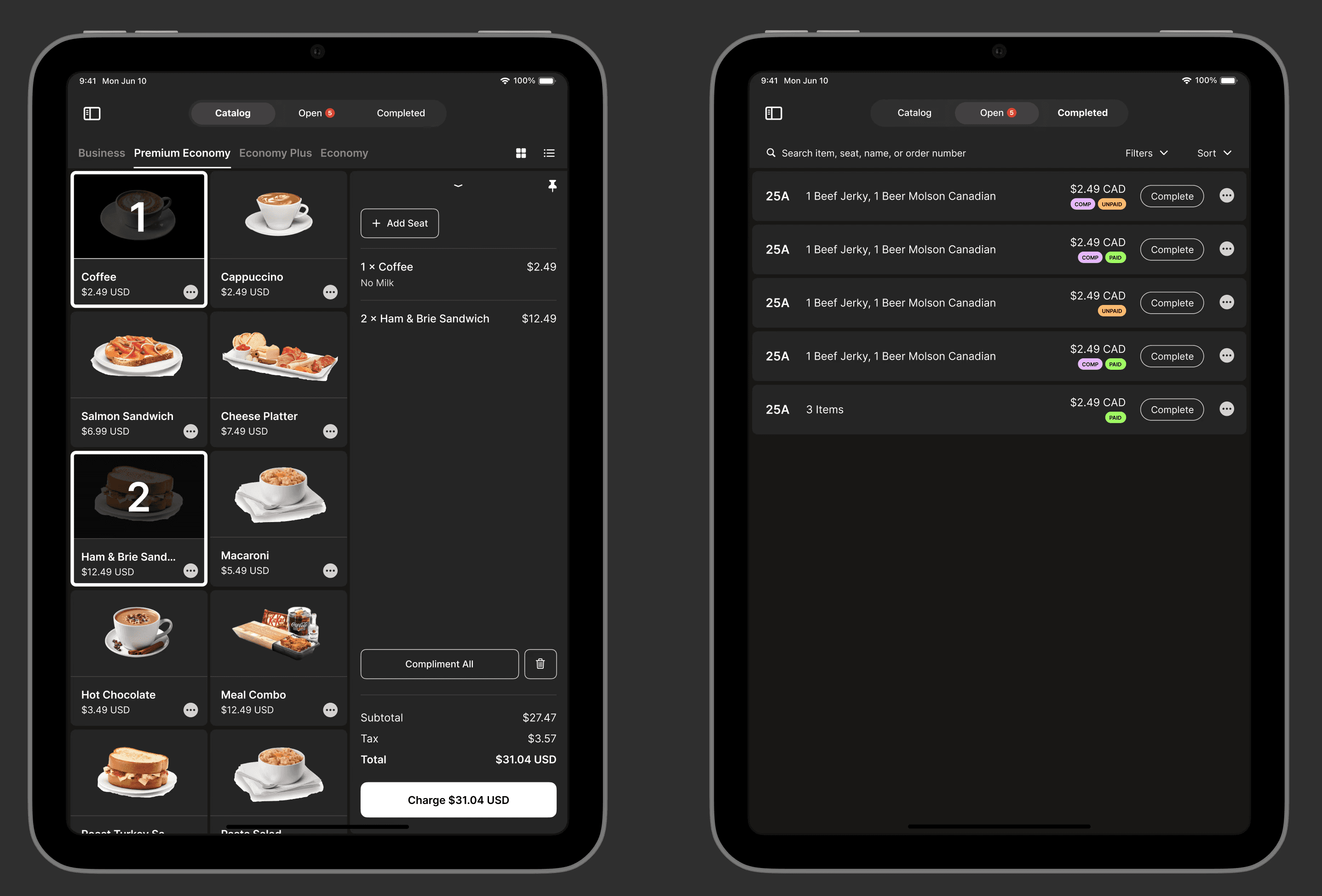
Dark Mode
Better and more comfortable usage In a dark cabin
Outcome
Food spoilage down, revenue up
The crew app starts up before the flight, allowing passengers to place orders anytime, even when waiting at the gate before takeoff.
These pre-flight orders allow the crew to stock precisely the required meals, taking only what's necessary, leaving unnecessary stock behind, and saving food and costs. Add the revenue from the additional meals sold, and the result is a big impact to the airline bottom line.
Using the crew app on 6 test flights in April 2024, Porter's crew reduced spoilage by 26% — a projected $1.54 million net positive return to Porter's bottom line over the span of a year.
Flexible UI for Faster Workflows
Prompted by observations of flight attendants, we introduced some flexibility in the UI to streamline users' workflows according to their situation.
In the catalog view, the user can switch between tile and list views, or dock or undock the sidebar.
Scrolling through a huge catalog? Undock the cart panel to show more items and scan faster for a specific one.
Comparing items? List view puts all your info in a line so prices are easy to scan.
The benefit: flight attendants fulfill orders faster and with more confidence.
Flexible UI
Unified Orders
Unified Order Command Center
The catalog, open orders, and completed orders screens are where the user spends a majority of their time in the app, and switching between these three screens was done by opening the ham menu — a two-tap operation.
I pushed across the org to unify these three screens into a lightly modified apple tab bar component. Now, switching between these screens only required one tap.
What was once three fragmented screens was now a unified screen. Create orders, fulfill orders placed on another device, or check completed orders — all just a tap away.
Smart Cabin
The smart cabin gives the crew app awareness of seat-number-to-cabin-class map on each flight. Using this map, validation ensures the correctness of each order.
If you're confused about which cabin class a seat is in, simply start your order with a seat number and the crew app can figure it out for you.
The result: fewer errors, and more confidence, and one less worry for the flight attendant.
Smart Cabin
Results
On 4 test flights in March 2025 with the crew app used, flight attendants sold an additional 4.5 items per flight, leading to a 26% reduction in spoilage.
The sale of these additional items, plus the savings from reduced spoilage, was $56 per flight and was projected to be approximately $1.54 million in net return for the airline per year.
From our improvements to the firmware updates, we decreased payment decline rates from ~6% to under 4%, a ~33% decrease and significant improvement to revenue loss.